About Nansu Juku
An online one-to-one tutoring school for children at local, international and Japanese schools outside Japan. As well as Maths, we support English, Physics, Chemistry, Biology and more, in line with each school's curriculum and each child's goals. From keeping up with day-to-day lessons to exam preparation and advice on future pathways and subject choices, we tailor our support to every student.
Subjects and teaching language vary by course, year group and tutor. Tell us what you are looking for when you get in touch.
Following each school’s curriculum
Different schools, different learning needs.
Even in the same year group, the order in which topics are taught, and the way exams expect answers to be written, differ from school to school and curriculum to curriculum. At Nansu Juku, we look at the school's pace, the student's own work and the topics they find hard, and build lessons around what that child needs.
We teach one-to-one at every stage, from primary and lower secondary to IGCSE, A-Level and the IB Diploma. Besides Maths, you can ask us about English, Physics, Chemistry, Biology and more, as well as future pathways and subject choices.
Connecting language and understanding
From the language they understand best, to skills they can use in the exam.
Some children can do the calculations but get stuck on the English wording of a question or on mathematical terms. We can work through the thinking in Japanese and then carry it over to English questions and answers, or teach entirely in English. Whichever suits your child's language background, we focus not only on the answer but on the thinking that leads to it.
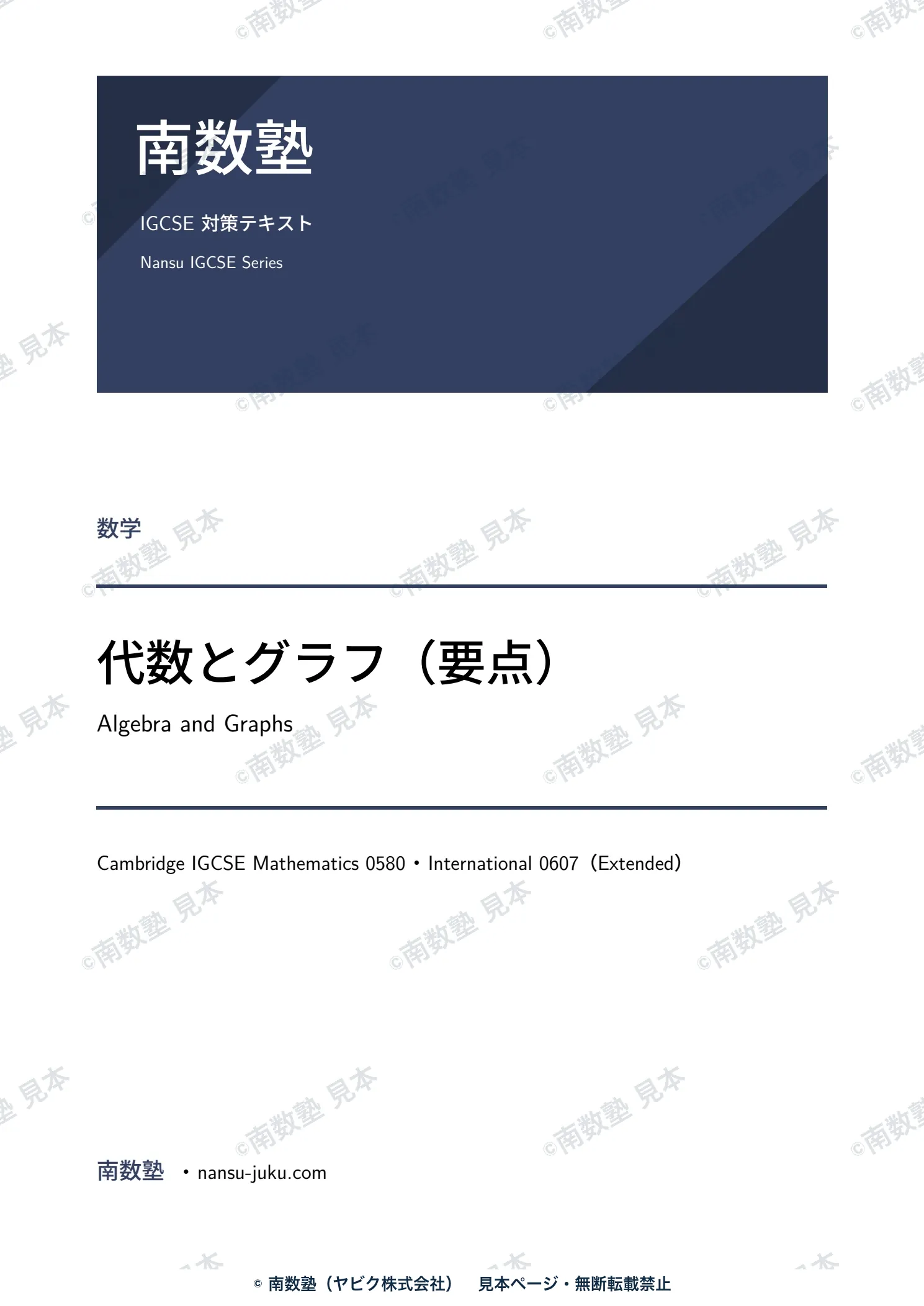
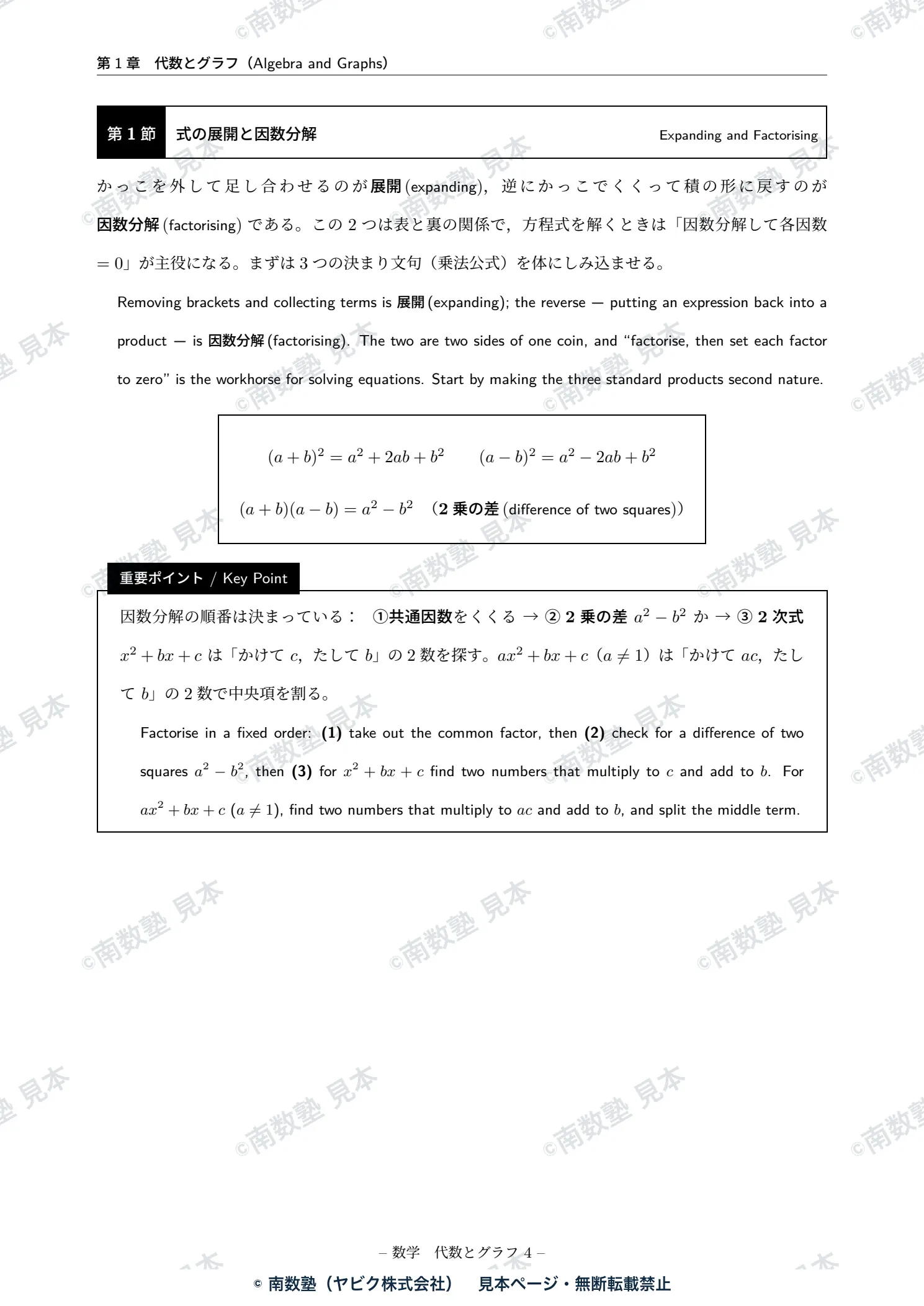
About our materialsFrom lessons to learning at home
Support that carries on until the next lesson, not just during this one.
So that what made sense in the lesson becomes something your child can solve alone, we combine personal homework and marking with bilingual (Japanese–English) materials, and use any sticking points to shape the next lesson. We keep families informed of progress through our dedicated portal, meetings and reports.
Personal homework and marking
From understanding in the lesson to solving problems alone.
Carried into the next lesson
We look at where they got stuck and build on it.
Shared with your family
Through our portal, meetings and reports.
What is Japanese-style maths?
In Japanese maths education, formulas and theorems are learnt together with when and why to use them. What decides the range of problems you can solve is not how many formulas you have memorised, but how precisely you choose between them.
Nansu Juku reshapes this way of learning into a form that works directly in international exams such as A-Level, IGCSE and the IB Diploma.
Knowing a formula and being able to use it in an exam are two different things. We teach the second.
The three-step learning method
Step 1: Understanding
Every topic starts with the why: where a formula comes from, and what it means.
Step 2: Logic
Learn how to set out a solution in logical steps that anyone can follow. Japanese maths education puts great weight on this.
Step 3: Practice
Put the method to work. Graded exercises take you from the basics to applied problems, building confidence and speed.
What makes it different
The biggest difference in Japanese maths education is the emphasis on how a solution is written. In many countries the goal is to reach the right answer; in Japan, the process that leads to it matters just as much.
A good solution tells a story. It states its assumptions, shows each step clearly and reaches a conclusion anyone can check. This structured approach develops genuine mathematical thinking, not just exam technique.
Our philosophy
Belief
We want to be chosen through fair competition, not through the power of the state or of capital. We believe that building value honestly, rather than chasing short-term profit, is what contributes to society in the long run. We simply keep doing what is right.
Vision
To become a global presence that people naturally recognise and trust. We want to prove once again what education from Japan can do in the world.
Mission
To give a push to people who are ready to take on a challenge. To show the way to people who are looking for one. And to help Japan regain its strength.
Why Japanese-style maths?
East Asian education has a real strength that holds its own anywhere in the world: the ability built through disciplined practice, and the depth of thinking that grows from understanding. We want to bring both to the world.
If something is excellent, it should compete. We believe that is good for everyone.
The typical approach vs Nansu Juku
| Typical | Nansu Juku | |
|---|---|---|
| Problem solving | Fragmented — jumps straight to the answer | Structured — states the approach, shows the steps, checks the result |
| Using formulas | Memorise and apply | Understand where it comes from, know when to use it, apply it strategically |
| Writing solutions | Answer-focused — minimal working shown | Process-focused — every step justified and explained |
| Practice style | Repeated drills of similar questions | A wide range of question types at graded difficulty |
| Connecting ideas | Each topic taught in isolation | Topics linked — each builds on what came before |
Operating company
Nansu Juku is operated by Yabiku Co., Ltd. Enquiries: info@yabiku-edu.com